case study
sad candy
holdings group
BRAND IDENTITY
ART DIRECTION
COPYWRITING
CREATIVE DEVELOPMENT
EDITORIAL DESIGN
INFORMATION DESIGN
VISUAL STORYTELLING
WORLD BUILDING
What if someone asked me to write a poem using graphic design?
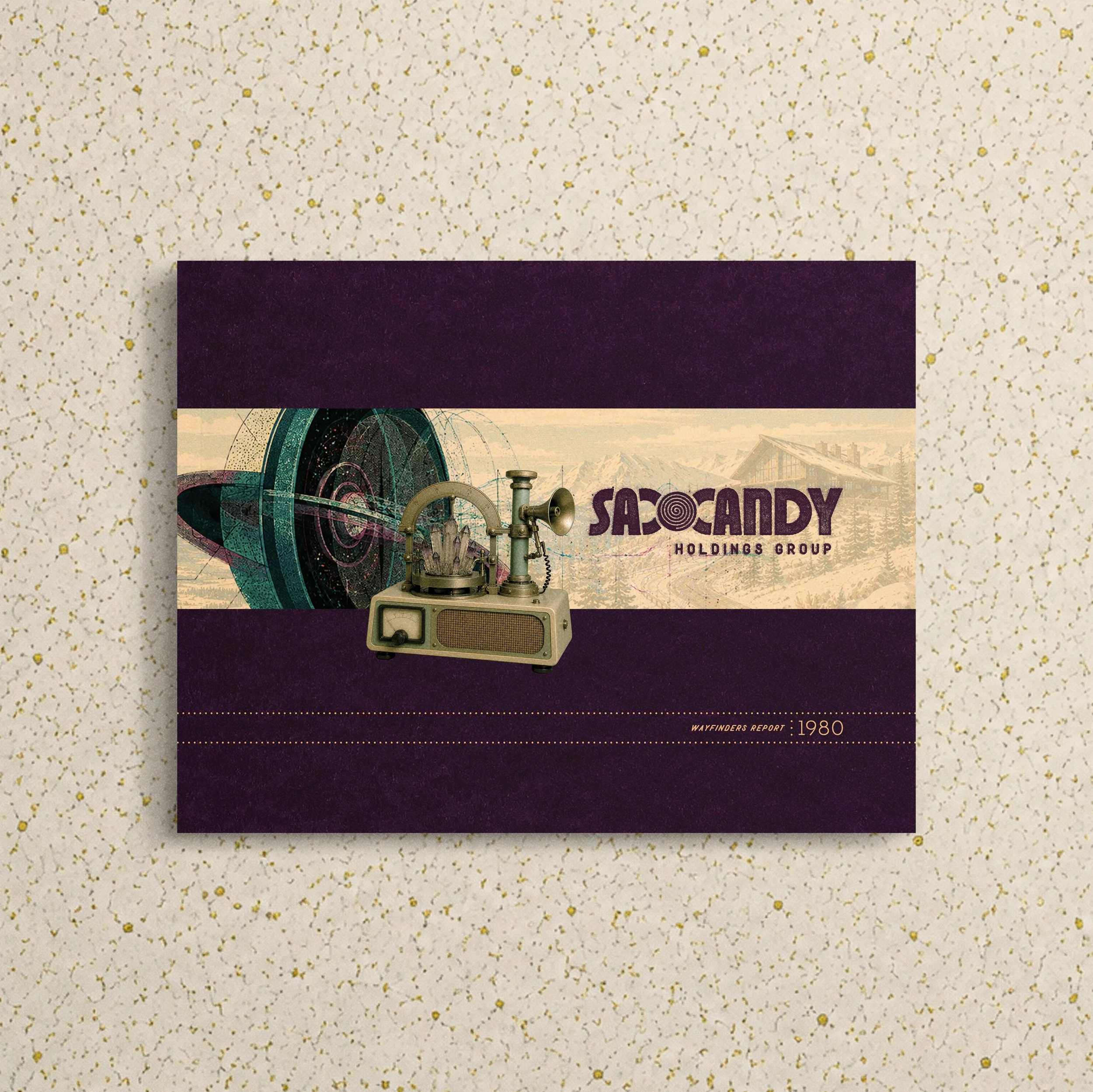
The Wayfinder’s Report is a fictional 1980 annual report for Sad Candy Holdings Group, a hospitality company founded to acquire and preserve unusual properties across the American landscape.
Created as part of The American Elsewhere Project, the 24-page report expands that world beyond individual destinations and imagines the organization responsible for studying them.
context
The American Elsewhere Project began by imagining fictional destinations with histories extending far beyond the moment they were designed.
The Wayfinder’s Report asks what happens when those places belong to something larger.
APPROACH
The project began with writing rather than layout.
The goal was to create a world strange enough to be impossible but structured enough to feel documented. That meant establishing rules.
Impossible phenomena are never presented as supernatural revelations. They are treated as ordinary operational concerns. Emotional experiences become measurable data. Memories can be persistent or negligible. A building can demonstrate Shared Memory Capacity. Dreams can resist normal decay.
From those rules came the visual system.
The report borrows from late-1970s and early-1980s corporate publications, technical manuals, scientific documentation, and institutional ephemera. Restrained grids and typography provide credibility while strange imagery, invented diagrams, coded annotations, data graphics, and unexpected artifacts gradually reveal that this is not an ordinary annual report.
SOLUTIONS
The finished 24-page report functions as both a corporate document and a piece of narrative world building.
Rather than explaining the fictional world directly, the story is distributed across the artifacts and information a real organization might produce: an executive letter, property profiles, operational statistics, and proprietary research equipment.
A series of invented instruments gives physical form to the company's methodology. Murakami's Oculus evaluates Echo Potential. Tonra's Solarist measures Dream Persistence. Sumiregawa's Hecate Device evaluates a property's tolerance for externally generated fiction. Time Drift Assessment records deviations in the expected passage and recurrence of time.
Each instrument was developed with a specific purpose, visual language, operating logic, and relationship to the larger Sad Candy research system. Traditional business metrics are replaced by measurements appropriate to this world. The absurdity is intentional. The presentation is not.
reflection
The Wayfinder’s Report became an exercise in designing not simply an identity, but an entire system of belief.
Creating the world required thinking beyond what Sad Candy looked like and asking how it operated. What would eventually become routine to people working somewhere the impossible happens every day?
The project also pushed The American Elsewhere Project in a new direction. Instead of designing another destination within the world, I designed an institution capable of connecting them.
The result is an artifact from a place that never existed, documenting phenomena that never happened, with enough evidence to suggest otherwise.